
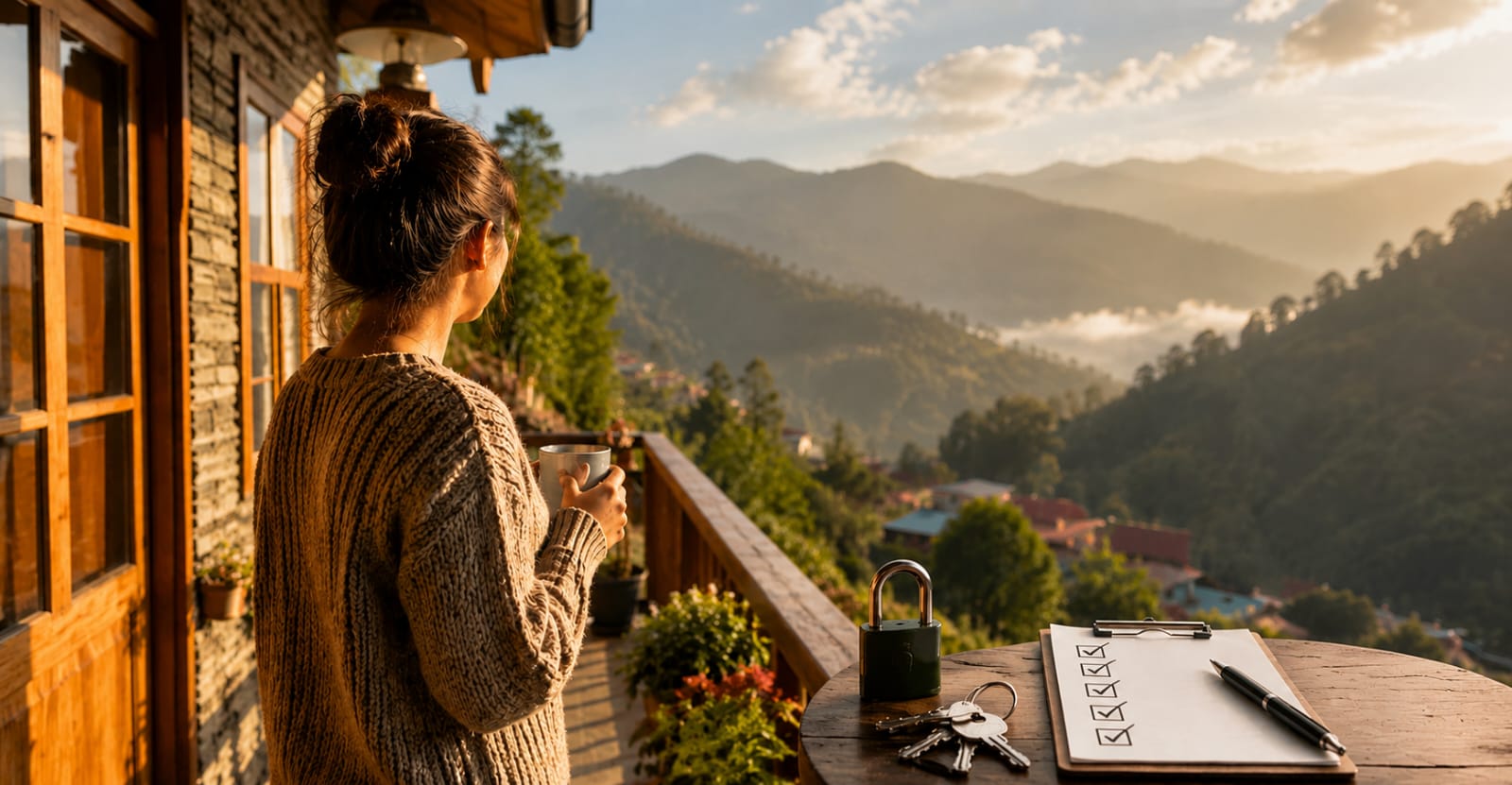
You find a beautiful homestay, the reviews look great and the price fits your budget. Then comes the thought: Is this place actually safe?
It is a fair question, especially when you are travelling alone, with family or somewhere unfamiliar. The good news is that a homestay can be a safe and comfortable way to travel when you know what to check.
Read this guide for practical homestay safety tips, real safety checks and simple ways to choose your stay with more confidence.
Are Homestays Safe in India?
Yes, homestays in India can be safe when travellers choose reliable platforms, check property details and reviews, and look for applicable government or local registration
The Ministry of Tourism has national standards for the classification of Incredible India Homestay Establishments. These standards cover aspects of accommodation and guest facilities. The Ministry also confirms that homestay classification under its national scheme is separate from registration, and classification fees apply to Silver and Gold categories.
This matters because verified homestays in India can mean different things. A property may have government classification, state registration or simply be listed on a private platform. Always check what verification actually means.
7 Homestay Safety Tips Every Traveller Should Follow
1. Check the host and property details
Before booking, look at the host profile, property address, contact details, photographs and recent reviews.
If the location is unclear or important details are missing, ask before you pay. A genuine host should be able to answer basic questions about the stay.
2. Read recent reviews, not just the rating
A 4.8-star rating looks reassuring, but the written reviews can tell you much more.
Look for repeated comments about cleanliness, neighbourhood, access, host behaviour, noise and whether the property matched its photographs.
This is one of the most important things to check before booking a homestay.
3. Check basic safety facilities
Ask whether the property has basic fire and emergency provisions.
The Ministry of Tourism's national homestay guidelines include safety-related provisions as part of its classification standards. Depending on the applicable category, these include facilities such as fire safety equipment and smoke or heat detectors.
Also check whether the entrance, stairs and room have adequate lighting and whether the room has a secure lock.
4. Understand the location
A beautiful property can still be inconvenient if it is isolated or difficult to reach.
Check the exact location on a map. Look at nearby roads, transport options, shops and medical facilities. If you are arriving late, ask the host about night-time access.
5. Ask about privacy
Before checking in, understand whether you will have a private room, private entrance or shared spaces.
If the property has cameras, ask where they are located. You should know what areas are private and what spaces are shared.
6. Do not rush an online payment
An unusually cheap deal can be tempting, especially when you are planning a trip on a budget.
India's National Cyber Crime Reporting Portal has warned about fake travel advertisements and websites used to collect money from travellers for fraudulent travel packages.
So, verify the property and payment details before transferring money. Be cautious if someone suddenly pressures you to pay through an unfamiliar account or changes the agreed payment process.
7. Keep important information handy
Save the host's contact number, property address and your booking details before travelling.
It is also sensible to know the nearest hospital, police station and transport option. This small step can make a big difference if something unexpected happens.
Why This Matters More Than Ever
India recorded 2,948.19 million domestic tourist visits in 2024, according to the Ministry of Tourism. That was a 17.51% increase from 2023.
With more people travelling across India, travellers are also exploring different types of stays. That makes knowing how to choose a safe homestay increasingly important.
How GharOnGo Can Help
GharOnGo is a homestay discovery and connection platform. Travellers can discover properties, explore available property information and connect with hosts before making a decision.
That gives you the opportunity to ask questions, understand the stay better and make an informed choice.
For hosts, GharOnGo offers free registration, the first 100 listings free, no hidden charges and no commissions.
GharOnGo does not guarantee the safety, availability, pricing or booking terms of a property. These details are agreed directly between the traveller and the property owner.
Your Homestay Safety Checklist
Before confirming your stay, ask yourself:
- Is the property information clear?
- Have I checked recent reviews?
- Do I understand the exact location?
- Have I asked about locks, fire safety and emergency access?
- Do I know the host's contact details?
- Are the payment details clear?
- Do I understand the privacy and house rules?
The Bottom Line
A safe stay starts before you reach the property. Check the details, ask questions and do not let an attractive price make you skip basic verification.
Ready to explore your options? Check out GharOnGo to discover homestays, learn about properties and connect with hosts before you decide where to stay.
Frequently Asked Questions
Are homestays safe for solo travellers in India?
They can be, but solo travellers should pay particular attention to the location, host details, reviews, room privacy, access and emergency contacts before booking.
How can I verify a homestay before booking?
Check the property information, recent reviews, exact location, host details and any applicable government or state registration. Do not assume that every online listing has government verification.
Is Homestay Legal in India?
Yes, homestays are legal in India, but the registration and operating requirements can vary by state and Union Territory. The Ministry of Tourism has a national framework for classifying homestays, while several states have their own registration and approval rules.